
Finding the best orthodontist for your child comes down to three things: specialty training, child-friendly care, and clear communication with parents. The right practice explains what’s happening in your child’s mouth, shows you the images, gives you a written plan, and never pressures you into starting treatment before it’s the right time.
Here’s what separates an orthodontist from a general dentist. After dental school, orthodontists complete two to three additional years of residency focused only on tooth movement, jaw growth, and bite correction. That extra training matters a lot when the patient is still growing.
A few markers worth checking:
Membership in the American Association of Orthodontists (AAO)
Board certification status
Real experience treating kids, not just adults
A team that knows how to talk to a nervous 8-year-old
Growing patients aren’t small adults. Their jaws are still developing, which opens up options that disappear later. At MyFamily Orthodontics, Dr. Lauris Johnson cares for patients of all ages, including early treatment for children whose bites need guidance while there’s still growth to work with.

How to Evaluate and Choose a Children’s Orthodontist: Step by Step
Choosing a children’s orthodontist breaks down into six steps: verify specialty credentials, confirm the first visit is free, ask which treatment options the practice offers, review the technology used, tour the office for comfort and scheduling, then compare written plans and payment terms side by side. Work through them in order and the right choice usually becomes obvious.
Step 1: Verify credentials and training. Ask directly where the doctor completed residency and whether she holds board certification. Dr. Johnson is a member of the ADA, AAO, SAO, and the Florida Dental Association.
Step 2: Confirm the first visit is free. A no-cost exam should include diagnostic records, digital X-rays, and photos. You shouldn’t pay to find out whether your child needs anything at all.
Step 3: Ask what treatment options are offered. A practice with metal braces, clear braces, clear aligners, and WildSmiles shaped brackets can match the plan to your child instead of the other way around.
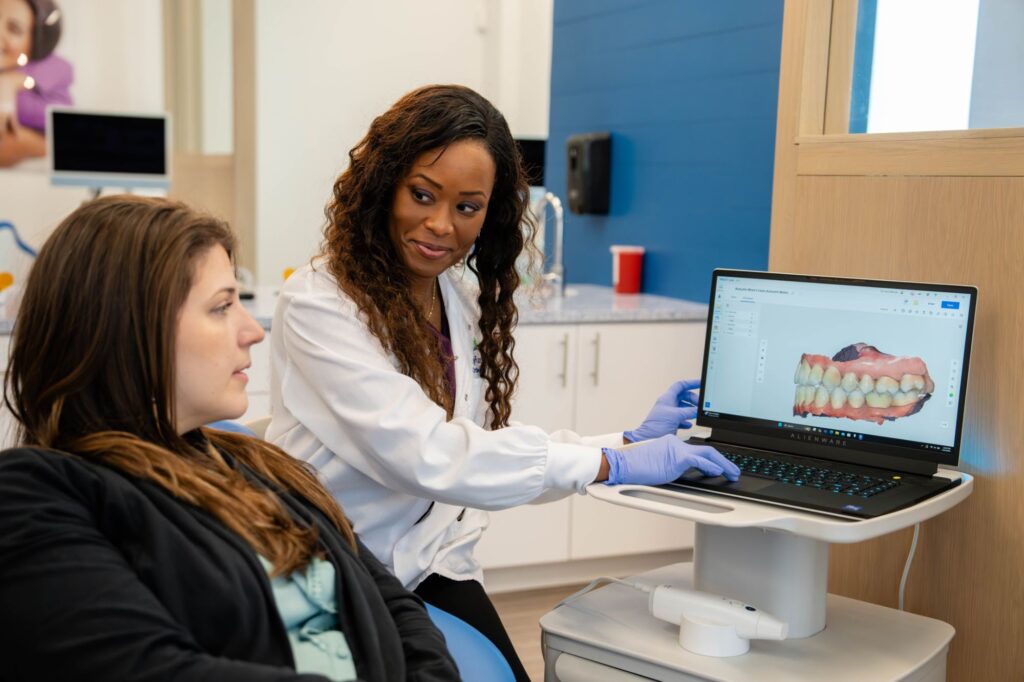
Step 4: Review the technology. Digital scans replace the goopy trays most parents remember. They’re faster, more accurate, and far more comfortable for a squirmy kid. Digital X-rays and digital photography round out the records.
Step 5: Look at comfort and convenience. Is the waiting room welcoming? Can you get after-school visits? Is there a virtual consult option for busy weeks?
Step 6: Compare the written plans. Ask for the estimated timeline, the appliance recommended, the total fee, and the monthly payment amount in writing. Then compare apples to apples.
Why an Age-7 Orthodontic Checkup Matters
The AAO recommends that every child have a first orthodontic evaluation by age 7. By then, enough permanent teeth have come in for Dr. Johnson to see how the bite is developing and how the jaws are growing.
Early evaluation catches things parents can’t see from the outside:
Crowding and spacing patterns
Crossbite, underbite, or overbite development
Jaw growth that’s tracking off-center
Teeth erupting in the wrong position
Extra or missing permanent teeth
Signs the bite may need a look:
Mouth breathing, especially during sleep
Thumb or finger sucking past age 5
Trouble chewing or biting into food
Baby teeth lost much earlier or later than siblings
A jaw that shifts to one side when closing
Guiding growth while it’s happening can simplify what comes later. Interceptive care makes room for permanent teeth and can reduce how much correction is needed in the teen years.
One thing that surprises many parents: most age-7 visits end with monitoring, not braces. We’ll check in periodically and start treatment only when the timing is right for your child. Every child grows on their own schedule, which is why the ongoing check-ins at MyFamily Orthodontics matter just as much as that very first exam.
Comparing Children’s Treatment Options: Braces, Clear Braces, and Aligners
Most children and teens choose between metal braces, clear braces, clear aligners, and WildSmiles shaped brackets. Metal braces handle the widest range of bite corrections for growing kids. Clear braces suit older teens who want something less noticeable. Clear aligners fit responsible teens with all their permanent teeth in. WildSmiles appeal to younger kids who want a say in how their braces look.
Kids and teens have more choices than they did a generation ago. Here’s how the main options compare.
| Option | Visibility | What it asks of your child | Hygiene | Best fit |
|---|---|---|---|---|
| Metal braces | Most noticeable | Nothing to remember; brackets stay on | Brush and floss carefully around brackets | Ages 8+ and the most versatile choice for growing patients |
| Clear braces | Blend with tooth color | Nothing to remember; avoid staining foods | Same care as metal braces | Older teens who want a lower-profile look |
| Clear aligners | Nearly invisible | 20-22 hours of wear daily, plus tracking trays | Easiest; remove to brush and floss | Responsible teens with all permanent teeth in |
| WildSmiles | Noticeable and fun | Nothing to remember | Same care as metal braces | Kids who want stars, hearts, footballs, or diamonds |
Metal braces are still the workhorse for a reason. They handle rotations, deep bites, and complicated cases that other options can’t, and modern stainless steel brackets are smaller and more comfortable than the ones you may remember.
WildSmiles change the conversation for younger kids. When your child gets to pick star-shaped or football-shaped brackets, braces stop feeling like something being done to them.
Clear aligners work beautifully for teens who will actually wear them. That’s the honest test. If the trays sit in a backpack, teeth don’t move, so Dr. Johnson talks candidly with families about whether the timing fits.
What Affects the Cost of Your Child’s Orthodontic Treatment
The cost of children’s orthodontic treatment depends on case complexity, how long treatment takes, and which appliance is used. A short Phase 1 plan costs less than a full two-year course of braces. Insurance benefits, FSA and HSA dollars, and monthly payment plans all reduce what your family pays out of pocket.
| Factor | How it affects cost |
|---|---|
| Severity of misalignment | Mild spacing needs less time and fewer visits than a significant bite correction |
| Phase 1 vs. full treatment | Early interceptive care is usually quoted separately from later braces |
| Appliance type | Expanders, clear aligners, and clear braces carry different fees than metal braces |
| Treatment length | Longer plans mean more visits and more adjustments |
| Retention | Retainers and follow-up care are part of the long-term picture |
Two-phase treatment often confuses families. Phase 1 guides jaw growth while your child is young. Phase 2 aligns the permanent teeth later. They’re typically quoted as two separate plans, so ask for both numbers when you’re comparing practices.
Ranges help you plan, but every case is priced on its own.
MyFamily Orthodontics offers affordable payment options built around real family budgets, and your free consultation includes a written estimate before you commit to anything, so there are no surprises later.
Is Your Child Ready for an Orthodontic Evaluation?
If your child is 7 or older, the answer is almost always yes. An evaluation isn’t a commitment to treatment. It’s information.
Good candidates for a first visit include:
Children 7 and up with crowding, gaps, or an uneven bite
Kids whose jaw shifts to one side when they bite down
Children who struggle to chew or bite into food
Kids still thumb sucking past the preschool years
Children who lost baby teeth unusually early or late
What about a child who still has mostly baby teeth? They can still benefit. Dr. Johnson can measure arch width, check jaw symmetry, and watch how permanent teeth are lining up underneath. Sometimes the most valuable outcome is simply a plan to recheck in a year.
Teens with their permanent teeth in are ready for full treatment, whether that’s braces or clear aligners.
Not sure where your child falls? A free consultation sorts it out. You can also start with a virtual consult from home, which is a low-pressure way to get Dr. Johnson’s read before booking a visit.
Frequently Asked Questions About Choosing a Children’s Orthodontist
At what age should my child first see an orthodontist?
By age 7, according to the American Association of Orthodontists. Enough permanent teeth have erupted by then for Dr. Johnson to spot developing crossbites, crowding, and jaw growth concerns. Most first visits result in monitoring rather than immediate treatment.
What’s the difference between an orthodontist and a family dentist?
Both graduate from dental school, but orthodontists complete two to three more years of residency devoted entirely to tooth movement, jaw growth, and bite correction. Your family dentist handles cleanings, cavities, and overall oral health. Dr. Johnson focuses only on alignment and bite, all day, every day.
Does my child need braces if their baby teeth are still in?
Usually not yet, but an evaluation still helps. Dr. Johnson can identify space shortages, jaw width concerns, and habits like thumb sucking that affect how permanent teeth come in. Catching those early sometimes means simpler treatment later.
How long does children’s orthodontic treatment take?
Most full treatment runs about 12 to 24 months, depending on complexity. Phase 1 interceptive care is often shorter, sometimes six to twelve months, followed by a resting period while permanent teeth erupt. Dr. Johnson gives you an estimated timeline in writing at your free consultation.
Should I get a second opinion on my child’s treatment plan?
Absolutely, and a good orthodontist will encourage it. Second opinions are especially worthwhile when plans differ significantly in length, appliance choice, or cost. Since consultations at MyFamily Orthodontics are free, getting another perspective only takes a little time.
What questions should I ask at the first consultation?
Ask what specific issues were found, what happens if you wait, which appliance options would work, how long treatment should take, and what the total fee and monthly payment look like. Also ask who you’ll see at each visit. Knowing your child will see the same familiar faces makes a real difference, because family is in our name because that’s what we are.